Factors Contributing to Rapid Decline of Arctic Sea Ice in Autumn


摘要
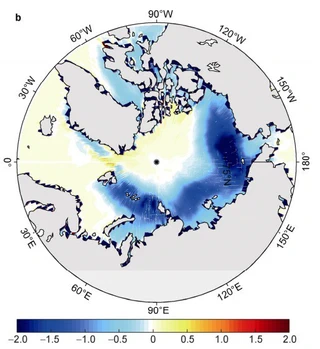
Autumn Arctic sea ice has been declining since the beginning of the era of satellite sea ice observations. In this study, we examined the factors contributing to the decline of autumn sea ice concentration. From the Beaufort Sea to the Barents Sea, autumn sea ice concentration has decreased considerably between 1982 and 2020, and the rates of decline were the highest around the Beaufort Sea. We calculated the correlation coefficients between sea ice extent(SIE) anomalies and anomalies of sea surface temperature(SST), surface air temperature(SAT) and specific humidity(SH). Among these coefficients, the largest absolute value was found in the coefficient between SIE and SAT anomalies for August to October, which has a value of-0.9446. The second largest absolute value was found in the coefficient between SIE and SH anomalies for September to November, which has a value of-0.9436. Among the correlation coefficients between SIE and SST anomalies, the largest absolute value was found in the coefficient for August to October, which has a value of-0.9410. We conducted empirical orthogonal function(EOF) analyses of sea ice, SST, SAT, SH, sea level pressure(SLP) and the wind field for the months where the absolute values of the correlation coefficient were the largest. The first EOFs of SST, SAT and SH account for 39.07%, 63.54% and 47.60% of the total variances, respectively, and are mainly concentrated in the area between the Beaufort Sea and the East Siberian Sea. The corresponding principal component time series also indicate positive trends. The first EOF of SLP explains 41.57% of the total variance. It is mostly negative in the central Arctic. Over the Beaufort, Chukchi and East Siberian seas, the zonal wind weakened while the meridional wind strengthened. Results from the correlation and EOF analyses further verified the effects of the ice–temperature, ice–SH and ice–SLP feedback mechanisms in the Arctic. These mechanisms accelerate melting and decrease the rate of formation of sea ice. In addition, stronger meridional winds favor the flow of warm air from lower latitudes towards the polar region, further promoting Arctic sea ice decline.
类型
出版物
Advances in Polar Science
Authors

Authors
副教授
数学与应用数学教研室主任,硕士研究生导师。博士毕业于中国海洋大学物理海洋学专业,主要从事人工智能海洋、大数据统计与分析、机器学习、极端事件归因等气候变化和海气相互作用的相关研究。主持及参与国家等课题10余项,先后发表国内外论文20余篇,其中中科院一区TOP论文影响因子6.5,博士论文下载次数达1700次;参与国家530航次调查任务,乘坐向阳红至赤道太平洋印度洋开展为期2个多月的科考任务;参与海军水文气象军工项目;承担本科生及研究生《高等数学》、《物理海洋学导论》等课程教学;

Authors
讲师
博士,硕士生导师,2016年1月从中国海洋大学海洋科学博士后流动站出站,3月进入青岛科技大学数理学院工作。主持多项科研项目,如国家自然科学基金青年基金、山东省海洋生态环境与防灾减灾重点实验室开放基金、青岛市博士后研究人员应用研究项目资助。

Authors
副教授
中国海洋大学博士,博士后,现任数学系副主任兼应用数学教研室主任,青岛市人工智能海洋技术创新中心骨干,发表高水平论文40余篇,承担国家自然科学基金、国家博士后基金、青岛市博士后基金以及人工智能技术开发项目等10余项。多次获得“青岛科技大学先进工作者”、“青岛科技大学先进女职工”、青岛科技大学毕业生“我最喜爱的教师”等荣誉称号;指导本科生和研究生参加数学建模竞赛,获得省级以上奖项10余项;主持参与多项研究生和本科生课程教改项目。
Authors
Authors

Authors
副教授
2004年毕业于上海大学,获硕士理学学位.2015年毕业于上海大学上海市应用数学与力学研究所,获博士工学学位.2015年–2018年在青岛科技大学动力工程与工程热物理流动站从事博士后研究,主要研究非线性偏微分方程的计算与应用、水动力学等问题.获山东省高等学校优秀科研成果奖两项(主持一项,参与一项).指导全国大学生和研究生数学建模竞赛,获国家奖一等奖一项,国家奖二等奖一项,省级奖若干;指导美国大学生数学建模竞赛,获国际一等奖一项、二等奖一项.

Authors
讲师
博士,讲师,硕士生导师,2018年9月毕业于东南大学控制理论与控制工程专业,获工学博士学位。主要研究方向为非线性系统分析与综合、智能控制、容错控制、神经网络控制等。主持山东省自然科学基金青年项目1项,复杂工程系统测量与控制教育部重点实验室开放课题1项。指导学生参加全国大学生数学建模竞赛、中国研究生数学建模竞赛等各类竞赛获国家一等奖1项、国家二等奖3项、国家三等奖1项、山东省一等奖12项、山东省二等奖6项、山东省三等奖2项。目前是青岛市人工智能海洋技术创新中心、青岛科技大学数学与交叉科学研究院和数理学院智能控制与机器视觉技术研究中心核心成员。
Authors