Causes of the Extreme Cold Event in December 2023 on Eastern China


摘要
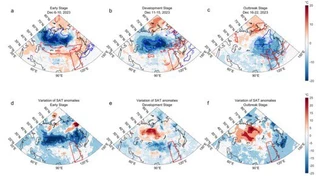
An extreme cold event outbreaks in Eastern China (EC) in December 16-22, 2023. Its maximum intensity (-8.30 degrees C) and duration (7 days) are in the second place in December during 1980-2023. In Early Stage (December 6-10), surface air temperature (SAT) anomalies reach the highest at 6.77 degrees C, exceeding mean value by two standard deviations. The variation of SAT anomalies (differences of SAT anomalies between the last day and the first day for a given period) is 0.60 degrees C. In Development Stage (December 11-15), SAT anomalies begin to decline but remain positive. In Outbreak Stage (December 16-22), the variation of SAT anomalies reaches a minimum of -3.17 degrees C, reflecting the cooling of EC. From December 1, cold air gradually gathers in Siberia under the influence of Arctic high moving southward. Cold air is locked in Siberia due to negative anomalies of geopotiential height (GH) and the westerlies anomalies between 40 degrees-50 degrees N. On December 11, these negative GH anomalies begin to move southeastward, and the westerlies anomalies weaken to a easterlies. From December 16-22, EC experiences an extreme cold event due to the southward of Arctic high and the eastward of Ural and Okhotsk high. On the basis of the zonal wind index (ZI) phase changes from negative to positive and the jet stream moves southeastward, the strong (weak) jet stream is spotted to block (promote) the southward of cold air. Linear regression shows that negative Arctic Oscillation (AO) conducts to the concentration of cold air in Siberia. Positive Siberia High (SH) pushes cold air to EC. SAT anomalies decrease by 2.29 degrees C in EC with the increase of 1 unit for SH. In empirical orthogonal function (EOF) analysis, EOF1 (28.07%) is characterized by warm Arctic and cold Siberia (WA-CS), which reflects the effect of SH on the occurrence of extreme cold events.
类型
出版物
Environmental Research Communications


Authors
副教授
数学与应用数学教研室主任,硕士研究生导师。博士毕业于中国海洋大学物理海洋学专业,主要从事人工智能海洋、大数据统计与分析、机器学习、极端事件归因等气候变化和海气相互作用的相关研究。主持及参与国家等课题10余项,先后发表国内外论文20余篇,其中中科院一区TOP论文影响因子6.5,博士论文下载次数达1700次;参与国家530航次调查任务,乘坐向阳红至赤道太平洋印度洋开展为期2个多月的科考任务;参与海军水文气象军工项目;承担本科生及研究生《高等数学》、《物理海洋学导论》等课程教学;
Authors
Authors


Authors