Assessing the Impact of Surface and Wind Profiler Data on Fog Forecasting Using WRF 3DVAR: An OSSE Study on a Dense Fog Event over North China


摘要
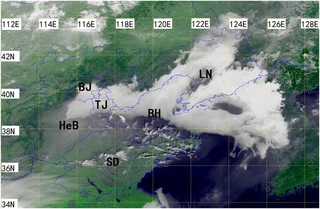
Because fog is a high-impact weather phenomenon, there has been increased demand for its accurate prediction. Both surface data and wind profiler data possess great potential for improved fog prediction. This study aimed to quantitatively assess the impact of surface and wind profiler data on fog prediction in terms of their spatial resolutions and distributions and also to assess the relative effect of these two types of observations. A dense fog event in northern China that occurred on 20 February 2007 was studied using the Weather Research and Forecasting (WRF) Model’s three-dimensional variational data assimilation (3DVAR) system with observing system simulation experiments (OSSE). The results indicated that the incorporation of surface data has an obvious positive impact on fog forecasts, especially with respect to effective assimilation of automated weather station data. Dense planetary boundary layer (PBL) wind profilers are more beneficial for fog forecasting than troposphere wind profilers, and an even spatial distribution over a large region is superior to a localized distribution. Surface data show greater benefit for fog forecasting than wind profiler data, with a 6.6% increase of skill score as a result of the improvement of near-surface thermal stratification. Moreover, combining both types of data greatly enhances fog predictive skill, with a 13.6% increase in skill score relative to the experiment assimilating only surface data, as a result of better dynamically balanced fields of thermodynamic and kinematic variables within the PBL with the assimilation of PBL wind profiler data.
类型
出版物
Journal of Applied Meteorology and Climatology
Fog
Automatic Weather Stations
Wind Profilers
Numerical Weather Prediction/Forecasting
Data Assimilation
Ensembles
海洋要素智能预报

Authors
Authors
Authors
Authors

Authors
讲师
博士,硕士生导师,2016年1月从中国海洋大学海洋科学博士后流动站出站,3月进入青岛科技大学数理学院工作。主持多项科研项目,如国家自然科学基金青年基金、山东省海洋生态环境与防灾减灾重点实验室开放基金、青岛市博士后研究人员应用研究项目资助。
Authors