Initiation and Evolution of Elevated Convection in a Nocturnal Squall Line Along the Meiyu Front
2018年7月27日·, ,,,,
,,,, ·
0 分钟阅读时长
·
0 分钟阅读时长
Kai Ma
Chuanyu Liu
徐俊丽
Fan Wang
Zhiwei He
Qinghong Zhang
Kun Zhao
胡慧琴
摘要
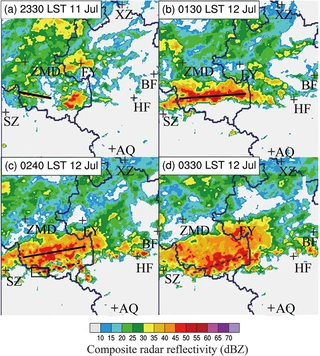
Observations and analyses from the Variational Doppler Radar Assimilation and Analysis System (VDRAS) were used to investigate the convection initiation mechanism of a nocturnal squall line along the Meiyu Front over central East China on 11–12 July 2014. The squall line occurred on the warm side of the Meiyu Front. The main convection in the squall line was initiated along a mesoscale convergence line above a stable boundary layer at about 2330 local standard time (LST) on 11 July. The convergence line intensified due to enhancement of southerly winds. Momentum budget analyses further revealed that the enhancement of the southerly winds was mainly contributed by an increasing horizontal pressure gradient term, which was associated with the eastward movement of a preexisting mesoscale vortex above the boundary layer and the strengthening of subtropical high. In the early morning of 12 July, a jump propagation of the squall line occurred. As the squall line matured, surface cold pools strengthened due to diabatic heating (most likely evaporative cooling). Then new convection began to initiate in front of the surface cold pools. During the jump propagation of the squall line, the elevated convection in the squall line transitioned to surface-based convection. This is the first study demonstrating the occurrence of elevated convection along the Meiyu Front and its transitioning to surface-based convection by jump propagation.
类型
出版物
Journal of Geophysical Research: Atmospheres
Authors
Authors

Authors
讲师
博士,硕士生导师,2016年1月从中国海洋大学海洋科学博士后流动站出站,3月进入青岛科技大学数理学院工作。主持多项科研项目,如国家自然科学基金青年基金、山东省海洋生态环境与防灾减灾重点实验室开放基金、青岛市博士后研究人员应用研究项目资助。
Authors
Authors
Authors
Authors
