Inversion of Wind-Stress Drag Coefficient in Simulating Storm Surges by Means of Regularization Technique

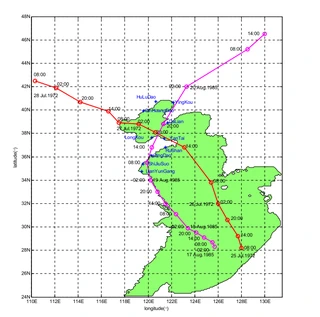 Image credit: Junli Xu
摘要
In this study, water levels observed at tide stations in the Bohai Sea, Yellow Sea, and East China Sea during Typhoons 7203 and 8509 were assimilated into a numerical assimilation storm surge model combined with regularization technique to study the wind-stress drag coefficient. The Tikhonov regularization technique with different regularization parameters was tested during the assimilation. Using the regularization technique, the storm surge elevations were successfully simulated in the whole sea areas during Typhoons 7203 and 8509. The storm surge elevations calculated with the regularization technique and the elevations calculated with independent point method were separately compared with the observed data. Comparison results demonstrated that the former was closer to the observed data. The regularization technique had the best performance when the regularization parameter was 100. The spatial distribution of the inverted drag coefficient, storm surge elevations, and the wind fields during both typhoons were presented. Simulated results indicated that the change of drag coefficient is more significant in the coastal regions of the Bohai Sea and north of the Yellow Sea. Further analysis showed that the rising water elevation in the Bohai Sea is mostly attributed to the influence of onshore winds, and the negative storm surge in the South Yellow Sea is mainly caused by offshore winds.
类型
出版物
International Journal of Environmental Research and Public Health

Authors
讲师
博士,硕士生导师,2016年1月从中国海洋大学海洋科学博士后流动站出站,3月进入青岛科技大学数理学院工作。主持多项科研项目,如国家自然科学基金青年基金、山东省海洋生态环境与防灾减灾重点实验室开放基金、青岛市博士后研究人员应用研究项目资助。
Authors
Authors
Authors