Application of Dynamically Constrained Interpolation Methodology in Simulating National-Scale Spatial Distribution of PM2.5 Concentrations in China

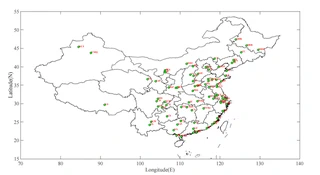 Image credit: Ning Li
摘要
Numerous studies have revealed that the sparse spatiotemporal distributions of ground-level PM2.5 measurements affect the accuracy of PM2.5 simulation, especially in large geographical regions. However, the high precision and stability of ground-level PM2.5 measurements make their role irreplaceable in PM2.5 simulations. This article applies a dynamically constrained interpolation methodology (DCIM) to evaluate sparse PM2.5 measurements captured at scattered monitoring sites for national-scale PM2.5 simulations and spatial distributions. The DCIM takes a PM2.5 transport model as a dynamic constraint and provides the characteristics of the spatiotemporal variations of key model parameters using the adjoint method to improve the accuracy of PM2.5 simulations. From the perspective of interpolation accuracy and effect, kriging interpolation and orthogonal polynomial fitting using Chebyshev basis functions (COPF), which have been proved to have high PM2.5 simulation accuracy, were adopted to make a comparative assessment of DCIM performance and accuracy. Results of the cross validation confirm the feasibility of the DCIM. A comparison between the final interpolated values and observations show that the DCIM is better for national-scale simulations than kriging or COPF. Furthermore, the DCIM presents smoother spatially interpolated distributions of the PM2.5 simulations with smaller simulation errors than the other two methods. Admittedly, the sparse PM2.5 measurements in a highly polluted region have a certain degree of influence on the interpolated distribution accuracy and rationality. To some extent, adding the right amount of observations can improve the effectiveness of the DCIM around existing monitoring sites. Compared with the kriging interpolation and COPF, the results show that the DCIM used in this study would be more helpful for providing reasonable information for monitoring PM2.5 pollution in China.
类型
出版物
Atmosphere
Ground-Level PM2.5 Simulation
Dynamically Constrained Interpolation Methodology
PM2.5 Transport Model; Kriging Interpolation
Orthogonal Polynomial Fitting
Chebyshev Basis Functions
其他
Authors

Authors
讲师
博士,硕士生导师,2016年1月从中国海洋大学海洋科学博士后流动站出站,3月进入青岛科技大学数理学院工作。主持多项科研项目,如国家自然科学基金青年基金、山东省海洋生态环境与防灾减灾重点实验室开放基金、青岛市博士后研究人员应用研究项目资助。
Authors