Assimilation Research of Wind Stress Drag Coefficient Based on the Linear Expression
2021年10月15日· ,,,
,,,
徐俊丽
Yuling Nie
Kai Ma
Wenqi Shi
Corresponding
,Xianqing Lv
Corresponding
·
0 分钟阅读时长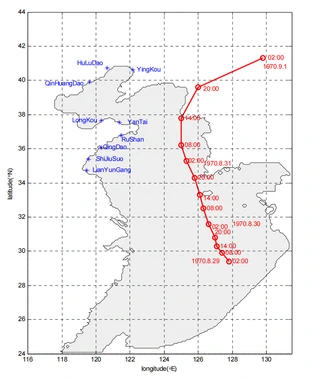 Image credit: Junli Xu
摘要
The wind stress drag coefficient plays an important role in storm surge models. This study reveals the influences of wind stress drag coefficients, which are given in form of formulas and inverted by the data assimilation method, on the storm surge levels in the Bohai Sea, Yellow Sea, and East China Sea during Typhoon 7008. In the process of data assimilation, the drag coefficient is based on the linear C-d = (a b x U-10) x 10(-3) (generally speaking, a and b are empirical parameters determined by observed data). The results showed that the performance of the data assimilation method was far superior to those of drag coefficient formulas. Additionally, the simulated storm surge levels obviously changed in the neighborhood of typhoon eye. Furthermore, the effect of initial values of a and b in the C-d on the storm surge levels was also investigated when employing the data assimilation method. The results indicated that the simulation of storm surge level was the closest to the observation when a and b were simultaneously equal to zero, whereas the simulations had slight differences when the initial values of a and b were separately equal to the drag coefficients from the work of Smith, Wu, and Geernaert et al.. Therefore, we should choose appropriate initial values for a and b by using the data assimilation method. As a whole, the data assimilation method is much better than drag coefficient parameterization formulas in the simulation of storm surges.
类型
出版物
Journal of Marine Science and Engineering

Authors
讲师
博士,硕士生导师,2016年1月从中国海洋大学海洋科学博士后流动站出站,3月进入青岛科技大学数理学院工作。主持多项科研项目,如国家自然科学基金青年基金、山东省海洋生态环境与防灾减灾重点实验室开放基金、青岛市博士后研究人员应用研究项目资助。
Authors
Authors
Authors
Authors