Source and Origin of the Interfacial Dzyaloshinskii-Moriya Interaction in a Heavy-Metal|magnetic-Insulator Bilayer
2018年8月1日·,, ,,,,,,,,,·
0 分钟阅读时长
,,,,,,,,,·
0 分钟阅读时长
Yong Zhao
Hong Qin
Xueying Zeng
徐俊丽
Junyu Dong
S. Y. Xia
T. Feng
B. Yang
G. Liu
Y. Z. Tian
P. Wang
X. G. Wan
Corresponding
,B. G. Wang
D. Wu
摘要
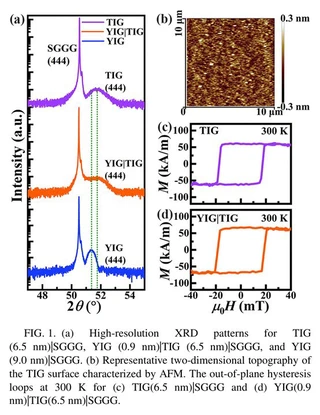
The interfacial Dzyaloshinskii-Moriya interaction (iDMI) was observed in the bilayer consisting of a heavy metal and a ferromagnetic insulator such as Pt vertical bar Tm3Fe5O12 (TIG), but the source and origin are still controversial. Here, we quantitatively investigate the iDMI strength in Pt vertical bar TIG by inserting a thin Y3Fe5O12 layer and/or a thin Cu layer between Pt and TIG. Our results suggest the iDMI contributed by both the Pt vertical bar TIG and the TIG vertical bar substrate interfaces. At the Pt vertical bar TIG interface, we find that Pt is essential for the strong iDMI. The disentangled iDMIs for Fe-Fe and Tm-Fe pairs are comparable, revealing that the Tm ions provide not only an additional Tm-Fe iDMI, but also the spin-orbit coupling to enhance the iDMI. At the TIG vertical bar substrate interface, the iDMI is attributed to the lattice-mismatch-induced deformation of the electron cloud for the ferromagnetic ions.
类型
出版物
Physical Review B
Authors
Authors
Authors

Authors
讲师
博士,硕士生导师,2016年1月从中国海洋大学海洋科学博士后流动站出站,3月进入青岛科技大学数理学院工作。主持多项科研项目,如国家自然科学基金青年基金、山东省海洋生态环境与防灾减灾重点实验室开放基金、青岛市博士后研究人员应用研究项目资助。
Authors
Authors
Authors
Authors
Authors
Authors
Authors
Authors
Authors
Authors