Estimating Subsurface Thermohaline Structure in the Tropical Western Pacific Using DO-ResNet Model


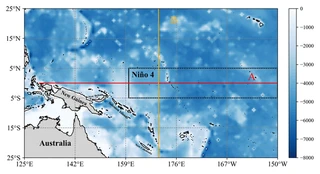 Image credit: Xianmei Zhou
摘要
Estimating the ocean’s subsurface thermohaline information from satellite measurements is essential for understanding ocean dynamics and the El Niño phenomenon. This paper proposes an improved double-output residual neural network (DO-ResNet) model to concurrently estimate the subsurface temperature (ST) and subsurface salinity (SS) in the tropical Western Pacific using multi-source remote sensing data, including sea surface temperature (SST), sea surface salinity (SSS),sea surface height anomaly (SSHA), sea surface wind (SSW), and geographical information (including longitude and latitude). In the model experiment, Argo data were used to train and validate the model, and the root mean square error (RMSE), normalized root mean square error (NRMSE), and coefficient of determination (R2) were employed to evaluate the model’s performance. The results showed that the sea surface parameters selected in this study have a positive effect on the estimation process, and the average RMSE and R2 values for estimating ST (SS) by the proposed model are 0.34 ◦C (0.05 psu) and 0.91 (0.95), respectively. Under the data conditions considered in this study,DO-ResNet demonstrates superior performance relative to the extreme gradient boosting model,random forest model, and artificial neural network model. Additionally, this study evaluates the model’s accuracy by comparing its estimations of ST and SS across different depths with Argo data, demonstrating the model’s ability to effectively capture the most spatial features, and by comparing NRMSE across different depths and seasons, the model demonstrates strong adaptability to seasonal variations. In conclusion, this research introduces a novel artificial intelligence technique for estimating ST and SS in the tropical Western Pacific Ocean.
类型
出版物
Atmosphere
Oceanography
Machine Learning
Ocean Thermohaline
Structure
Remote Sensing Data
Tropical Western Pacific
海洋要素智能预报


Authors
正教授
博士,教授,硕士生导师,人工智能技术海洋场景化应用山东省工程研究中心副主任,青岛市人工智能海洋技术创新中心副主任,青岛科技大学数学与交叉研究院副院长。山东赛区数学建模竞赛专家组成员、山东省数学会理事、山东省应用统计学会理事、人工智能海洋学专业委员会委员。近年来,主持或参与国家自然科学基金、省自然基金、省教改项目等各类教学科研项目20多项,在国内外期刊发表学术论文80余篇,其中被SCI、EI检索70余篇,参编教材1部。指导学生参加全国大学生数学建模竞赛、中国研究生数学建模竞赛、美国大学生数学建模竞赛等各类竞赛获国家一等奖9项、国家二等奖29项、国家三等奖13项、山东省一等奖37项、山东省二等奖12项、山东省三等奖7项。指导本科生参加国家大学生创新计划项目4项。

