Spatio-Temporal Variations of Arctic Amplification and Their Linkage with the Arctic Oscillation

摘要
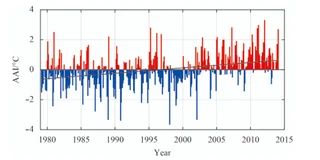
The Arctic near-surface air temperatures are increasing more than twice as fast as the global average–a feature known as Arctic amplification (AA). A modified AA index is constructed in this paper to emphasize the contrast of warming rate between polar and mid-latitude regions, as well as the spatial and temporal characteristics of AA and their influence on atmospheric circulation over the Northern Hemisphere. Results show that AA has a pronounced annual cycle. The positive or negative phase activities are the strongest in autumn and winter, the weakest in summer. After experiencing a remarkable decadal shift from negative to positive phase in the early global warming hiatus period, the AA has entered into a state of being enlarged continuously, and the decadal regime shift of AA in about 2002 is affected mainly by decadal shift in autumn. In terms of spatial distribution, AA has maximum warming near the surface in almost all seasons except in summer. Poleward of 20°N, AA in autumn has a significant influence on the atmospheric circulation in the following winter. The reason may be that the autumn AA increases the amplitude of planetary waves, slows the wave speeds and weakens upper-level zonal winds through the thermal wind relation, thus influencing surface air temperature in the following winter. The AA correlates to negative phase of the Arctic oscillation (AO) and leads AO by 0–3 months within the period 1979–2002. However, weaker relationship between them is indistinctive after the decadal shift of AA.
类型
出版物
Acta Oceanologica Sinica
Authors
Authors

Authors
讲师
2015年10月至2019年8月在中国海洋大学物理海洋教育部重点实验室从事博士后研究工作.2021年起任青岛科技大学物理系讲师,2024年仍在该校任教.青岛科技大学物理系讲师,主要从事海气相互作用及CESM应用研究。她在教学领域表现突出,先后获得山东省第七届高校青年教师教学比赛一等奖(2020年)、第六届’超星杯’教学比赛复赛资格(2024年).科研方面,其主持的2024年国家自然科学基金青年项目获批.指导学生方面,2022-2023学年担任应用物理专业6名本科生导师