Fertilization of the Northwest Pacific Ocean by East Asia Air Pollutants
2019年5月6日·,,,,,, ,
,
Chao Zhang
Akinori Ito
Zongbo Shi
Maki Noguchi Aita
Xiaohong Yao
Qiang Chu
Jinhui Shi
宫响
Huiwang Gao
Corresponding
·
0 分钟阅读时长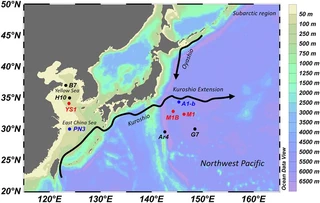
摘要
Haze particles as a key air pollutant contain high level of toxins, which were hypothesized to inhibit phytoplankton growth when deposited to the ocean, and thus indirectly affect the climate. However, field observations have yet to provide conclusive evidence to confirm this hypothesis. Onboard microcosm experiments in the Northwest Pacific Ocean (NWPO) show that haze particles collected at the East Asia continent had an inhibition impact on phytoplankton growth only when at very high particle loading (2 mg/L). In contrast, haze particles at low and medium loadings (0.03-0.6 mg/L) stimulated phytoplankton growth and shifted phytoplankton size structure toward larger cells, primarily due to the supply of inorganic nitrogen nutrients from the particles. Model simulations showed that haze particle loading in NWPO surface seawater was usually more than an order of magnitude lower than 2 mg/L. This indicates that haze particles are unlikely to cause harm but to stimulate phytoplankton growth in the nitrogen-limited NWPO. Ocean biogeochemical modeling further shows that deposited nitrogen significantly enhanced surface ocean chlorophyll a concentration in the winter and spring of 2014. Overall, these results demonstrate that haze particles stimulate rather than inhibit primary production in the NWPO. Plain Language Summary Increasing anthropogenic emissions of air pollutants from fast-developing East Asia leads to increasing deposition of aerosol particles to the Northwest Pacific Ocean (NWPO). Such particles contain both nutrients such as nitrogen and phosphorus and toxins such as copper and organic pollutants to the marine phytoplankton, which have contrasting effects on marine ecosystems and carbon uptake. However, the actual impact remains unknown. Detailed onboard incubation experiments confirm that Chinese haze particles have an overall stimulation effects on phytoplankton under representative ocean conditions in NWPO. Toxicity to phytoplankton is only observed when the added haze particle concentration is unrealistically high. Simulations suggest that nitrogen in the atmospheric deposition contributes significantly to the surface chlorophyll a concentration in NWPO and enhances carbon fixation, which indirectly offsets global warming.
类型
出版物
Global Biogeochemical Cycles
Aerosol
Anthropogenic Nitrogen
China
Deposition
Dust
Feedbacks
Iron
Phytoplankton Growth
Promotion
Yellow Sea
海洋数值模式
Authors
Authors
Authors
Authors
Authors
Authors
Authors

Authors
副教授
中国海洋大学博士,博士后,现任数学系副主任兼应用数学教研室主任,青岛市人工智能海洋技术创新中心骨干,发表高水平论文40余篇,承担国家自然科学基金、国家博士后基金、青岛市博士后基金以及人工智能技术开发项目等10余项。多次获得“青岛科技大学先进工作者”、“青岛科技大学先进女职工”、青岛科技大学毕业生“我最喜爱的教师”等荣誉称号;指导本科生和研究生参加数学建模竞赛,获得省级以上奖项10余项;主持参与多项研究生和本科生课程教改项目。
Authors