The Precipitation Variability of the Wet and Dry Season at the Interannual and Interdecadal Scales over Eastern China (1901–2016): The Impacts of the Pacific Ocean

摘要
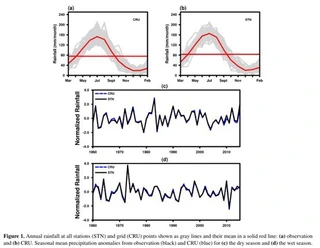
The spatiotemporal variability of rainfall in the dry (October-March) and wet (April-September) seasons over eastern China is examined from 1901-2016 based on the gridded rainfall dataset from the University of East Anglia Climatic Research Unit. Principal component analysis is employed to identify the dominant variability modes, wavelet coherence is utilized to investigate the spectral features of the leading modes of precipitation and their coherences with the large-scale modes of climate variability, and the Bayesian dynamical linear model is adopted to quantify the time-varying correlations between climate variability modes and rainfall in the dry and wet seasons. Results show that first and second principal components (PCs) account for 34.2 % (16.1 %) and 13.4 % (13.9 %) of the variance in the dry (wet) season, and their variations are roughly coincident with phase shifts of the El Nino-Southern Oscillation (ENSO) in both seasons. The anomalous moisture fluxes responsible for the occurrence of precipitation events in eastern China exhibit an asymmetry between high and light rainfall years in the dry (wet) season. The ENSO has a 4- to 8-year signal of the statistically positive (negative) association with rainfall during the dry (wet) season over eastern China. The statistically significant positive (negative) associations between the Pacific Decadal Oscillation (PDO) and precipitation are found with a 9- to 15-year (4- to 7-year) signal. The impacts of the PDO on rainfall in eastern China exhibit multiple timescales as compared to the ENSO episodes, while the PDO triggers a stronger effect on precipitation in the wet season than the dry half year. The interannual and interdecadal variations in rain-fall over eastern China are substantially modulated by drivers originated from the Pacific Ocean. During the wet season, the ENSO exerted a gradually weakening effect on eastern China rainfall from 1901 to 2016, while the effects of the PDO decreased before the 1980s, and then shifted into increases after the 2000s. The finding provides a metric for assessing the capability of climate models and guidance of seasonal prediction.
类型
出版物
Hydrology and Earth System Sciences
Authors
Authors
Authors
Authors

Authors
副教授
中国海洋大学博士,博士后,现任数学系副主任兼应用数学教研室主任,青岛市人工智能海洋技术创新中心骨干,发表高水平论文40余篇,承担国家自然科学基金、国家博士后基金、青岛市博士后基金以及人工智能技术开发项目等10余项。多次获得“青岛科技大学先进工作者”、“青岛科技大学先进女职工”、青岛科技大学毕业生“我最喜爱的教师”等荣誉称号;指导本科生和研究生参加数学建模竞赛,获得省级以上奖项10余项;主持参与多项研究生和本科生课程教改项目。
Authors