Hydrographic Control on Subsurface Chlorophyll Maximum in the Northern South China Sea in Autumn
2024年8月14日· ,,,
,,,
宫响
Hui Liu
Xun Gong
Corresponding
,Jiyao Liu
Huiwang Gao
Corresponding
·
0 分钟阅读时长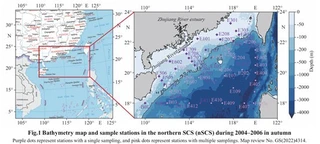
摘要
As a frequently-observed phenomenon in the northern South China Sea (nSCS),subsurface chlorophyll maximum (SCM) evolution from summer to winter remains unclear,neither the associated hydrographic control.In this study,on the basis of in-situ data of fall-season cruises in 2004–2006,we characterized the depth,thickness and intensity of the SCM in the nS CS using a general Gaussian-function fitting approach,and investigated a linkage to the corresponding ocean vertical buoyance properties.Our results show that the SCM becomes deeper,thicker and less intense offshore-wards in the nS CS during fall seasons.In parallel,a correlation between the SCM variation and mixed layer depth exists in the nSCS,and it becomes pronounced in the shelf region compared to the slope and basin areas in autumn.Physically,once warmer surface ocean and thus stronger thermo-determined stratification,the SCM layer goes deeper and becomes thicker and less intense in the nSCS,especially in the shelf area of the nSCS.Moreover,the impact of water temperatures at deeper layers on the vertical stratification exerts more consequent roles on the spatial variability of SCM,compared to surface temperatures in the nSCS.Specifically,the isotherm line of 22°C acts as crucial indicator for variations of the SCM in the nSCS during autumns.
类型
出版物
Journal of Oceanology and Limnology
Subsurface Chlorophyll Maximum (SCM)
Northern South China Sea (NSCS)
Autumn Season
Hydrographic Control
海洋大数据

Authors
副教授
中国海洋大学博士,博士后,现任数学系副主任兼应用数学教研室主任,青岛市人工智能海洋技术创新中心骨干,发表高水平论文40余篇,承担国家自然科学基金、国家博士后基金、青岛市博士后基金以及人工智能技术开发项目等10余项。多次获得“青岛科技大学先进工作者”、“青岛科技大学先进女职工”、青岛科技大学毕业生“我最喜爱的教师”等荣誉称号;指导本科生和研究生参加数学建模竞赛,获得省级以上奖项10余项;主持参与多项研究生和本科生课程教改项目。
Authors
Authors
Authors
Authors