Multi-Routine-Data Driven Spatio-Temporal Short-Term Predictions for Surface Ozone in China

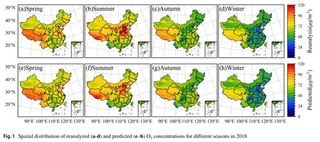
Ozone (O3) is a major atmospheric pollutant, and accurate prediction of its concentrations remains challenging due to its complex nonlinear relationships with precursor compounds. Existing machine learning methods have mainly focused on single-site or spatial predictions, lacking research on spatio-temporal short-term predictions based on simple factors. To address this gap, the MRD-O3former, a deep learning model driven by multi-routine data, was developed to predict short-term hourly spatio-temporal surface ozone concentrations over China. The model exhibits strong spatio-temporal consistency, achieving a high correlation coefficient (r2=0.85 similar to 0.90 documentclass[12pt]minimal usepackageamsmath usepackagewasysym usepackageamsfonts usepackageamssymb usepackageamsbsy usepackagemathrsfs usepackageupgreek setlength oddsidemargin-69pt begindocument
$$r2 = 0.85 sim 0.90$$enddocument) and low normalized mean biases (NMBs) between -15% and 15% at the national scale compared to reanalysis ozone data. Both ablation experiments and permutation importance analysis reveal that historical ozone levels play a primary role in next-day ozone prediction, while meteorological factors such as wind speed and temperature also make significant contributions. Regional validation confirms the model’s effectiveness in the Beijing-Tianjin-Hebei region. Moreover, the study investigates the differential impact of crucial factors in urban and rural areas, revealing that historical ozone levels and meteorological factors significantly influence rural areas. However, the influence of historical ozone levels on urban ozone prediction is relatively small, especially during the summer. This suggests that urban ozone undergoes rapid formation and removal processes. These findings highlight the promising potential of deep learning techniques in accurately predicting spatiotemporal short-term ozone concentrations and interpreting the mechanism and source for ozone pollution.
