Using Ensemble Adjustment Kalman Filter to Assimilate Argo Profiles in a Global OGCM


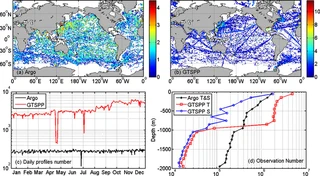 Image credit: Xunqiang Yin
摘要
An ensemble adjustment Kalman filter (EAKF) is used to assimilate Argo profiles of 2008 in a global version of the Modular Ocean Model version 4. Four assimilation experiments are carried out to compare with the simulation without data assimilation, which serves as the control experiment. All experiment results are compared with dataset of Global Temperature–Salinity Profile Program and satellite sea surface temperature (SST). The first experiment (Exp 1) is implemented by perturbing temperature of upper layers in the initial conditions (ICs) with an amplitude of 1.0°C and no ensemble inflation. The results from Exp 1 show that the simulated temperature (salinity) deviation in the upper 400m (500m) is reduced through Argo data assimilation; however, these deviations are increased in deeper layers. The error reduction in SST is much greater during January to June than during the rest of the year. Three more experiments are designed to understand the responses in different layers and months. Two of them test model sensitivities to ICs by perturbing them vertically: one over the vertical extent of the whole water column (Exp 2) and the other employs smaller perturbation amplitude of 0.1°C (Exp 3). Exp 2 shows that the simulated temperature and salinity deviations are systematically improved in the whole water column. Comparison between Exps 2 and 3 suggests that perturbation amplitude is important. Exp 4 tests the influence of the optimal inflation factor of 5%, which is determined by other set of numerical tests. Exp 4 improves assimilation performance much more than the other three experiments without inflation. Therefore, we conclude that the perturbation should be introduced to all model layers, proper perturbation amplitude is important for Ocean data assimilation using EAKF, and the ensemble inflation by an optimal inflation is critical to improve the skill of the EAKF analysis.
类型
出版物
Ocean Dynamics
Argo Profiles
Ocean Data Assimilation
EAKF
GPerturbation of the Initial Conditions
Ensemble Inflation
海洋数值模式

Authors
副研究员
主要致力于海洋数值模拟与数据同化研究,在国内外杂志上发表文章60余篇,承担了国家基金项目、国家973课题、公益性行业专项课题和重点研发计划等多项研究任务。近年来,在多变量联合同化调整和高效并行计算等研究方面取得重要成果,发展了海洋全要素高效并行数据同化系统,有效提高了海洋预报能力和气候预测水平,发布了我国首套全球高分辨率再分析数据。基于Kalman滤波原理,通过变量间的协方差表征海洋动力学特征以及多种影响因素之间的相互作用,有效利用观测信息优化其周围网的各种变量,实现多变量联合同化调整。作为核心成员,突破了负载近绝对均衡、主从核协同计算框架设计和循环折叠流水线等若干关键技术,为海洋数值预报系统建设提供了技术支撑。据此研发了海洋全要素高效并行数据同化系统,已成功应用到21世纪海上丝绸之路海洋环境预报、第二代海洋环境保障等多个预报系统,并支撑了气候预测和观测设计优化等研究的开展。
Authors

Authors
特聘研究员
研究员,自然资源部高层次科技创新人才工程“青年科技人才”、自然资源部第一海洋研究所束星北青年学者,是山东省自然科学基金杰出青年基金获得者。主要从事极地海洋学和极地气候变领域的研究工作,围绕北极气候变化,在气候变化机理研究、气候模式评估与改进和气候预测预估等方面取得了系列创新成果, 主要包括:研究揭示了北冰洋大西洋化进程中海-(冰)-气热通量在冰区与非冰区的相反变化规律,发现了“北冰洋放大”现象,阐明了北冰洋的快速变暖机制;系统评估了气候模式对北极海冰和北冰洋的模拟能力,量化了气候模式在北冰洋快速气候变化模拟中的共性偏差,改进提升了自主气候模式在北极的模拟能力;研发了北极海冰短期气候预测系统,构建了北冰洋动力降尺度数据集,成功应用于我国北极科考和北极航道商业航运的保障与规划。在《Nature Communications》、《Science Advances》、《Geophysical Research Letters》、和《Journal of Geophysical Research: Oceans》等期刊发表研究论文90余篇。