Argo Data Assimilation in Ocean General Circulation Model of Northwest Pacific Ocean
2012年7月15日· ,,,·
0 分钟阅读时长
,,,·
0 分钟阅读时长
尹训强
Corresponding
,Fangli Qiao
Yongzeng Yang
Changshui Xia
Xianyao Chen
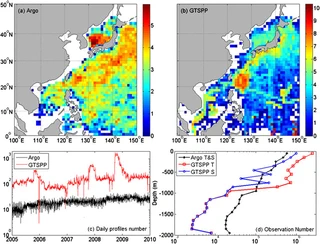 Image credit: Xunqiang Yin
摘要
The Argo temperature and salinity profiles in 2005–2009 are assimilated into a coastal ocean general circulation model of the Northwest Pacific Ocean using the ensemble adjustment Kalman filter (EAKF). Three numerical tests, including the control run (CTL) (without data assimilation, which serves as the reference experiment), ensemble free run (EnFR) (without data assimilation), and EAKF experiment (with Argo data assimilation using EAKF), are carried out to examine the performance of this system. Using the restarts of different years as the initial conditions of the ensemble integrations, the ensemble spreads from EnFR and EAKF are all kept at a finite value after a sharp decreasing in the first few months because of the sensitive of the model to the initial conditions, and the reducing of the ensemble spread due to Argo data assimilation is not much. The ensemble samples obtained in this way can well represent the probabilities of the real ocean states, and no ensemble inflation is necessary for this EAKF experiment. Different experiment results are compared with satellite sea surface temperature (SST) data and the Global Temperature-Salinity Profile Program (GTSPP) data. The comparison of SST shows that modeled SST errors are reduced after data assimilation; the error reduction percentage after assimilating the Argo profiles is about 10 % on average. The comparison against the GTSPP profiles, which are independent of the Argo profiles, shows improvements in both temperature and salinity. The comparison results indicated a great error reduction in all vertical layers relative to CTL and the ensemble mean of EnFR; the maximum value for temperature and salinity reaches to 85 % and 80 %, respectively. The standard deviations of sea surface height are employed to examine the simulation ability, and it is shown that the mesoscale variability is improved after Argo data assimilation, especially in the Kuroshio extension area and along the section of 10°N. All these results suggest that this system is potentially useful for improving the simulation ability of oceanic numerical models.
类型
出版物
Ocean Dynamics
Argo Profiles
Ensemble Adjustment Kalman Filter
Ensemble Free Runs
Ensemble Spread
Mesoscale Variability
海洋数值模式

Authors
副研究员
主要致力于海洋数值模拟与数据同化研究,在国内外杂志上发表文章60余篇,承担了国家基金项目、国家973课题、公益性行业专项课题和重点研发计划等多项研究任务。近年来,在多变量联合同化调整和高效并行计算等研究方面取得重要成果,发展了海洋全要素高效并行数据同化系统,有效提高了海洋预报能力和气候预测水平,发布了我国首套全球高分辨率再分析数据。基于Kalman滤波原理,通过变量间的协方差表征海洋动力学特征以及多种影响因素之间的相互作用,有效利用观测信息优化其周围网的各种变量,实现多变量联合同化调整。作为核心成员,突破了负载近绝对均衡、主从核协同计算框架设计和循环折叠流水线等若干关键技术,为海洋数值预报系统建设提供了技术支撑。据此研发了海洋全要素高效并行数据同化系统,已成功应用到21世纪海上丝绸之路海洋环境预报、第二代海洋环境保障等多个预报系统,并支撑了气候预测和观测设计优化等研究的开展。
Authors
Authors
Authors
Authors