Ocean Satellite Data Assimilation Experiments in FIO-ESM Using Ensemble Adjustment Kalman Filter

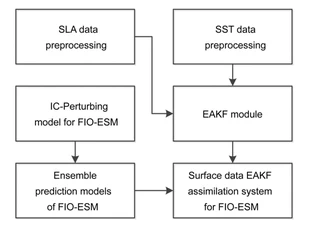 Image credit: Hui Chen
摘要
Using Ensemble Adjustment Kalman Filter (EAKF), two types of ocean satellite datasets were assimilated into the First Institute of Oceanography Earth System Model (FIO-ESM), v1.0. One control experiment without data assimilation and four assimilation experiments were conducted. All the experiments were ensemble runs for 1-year period and each ensemble started from different initial conditions. One assimilation experiment was designed to assimilate sea level anomaly (SLA); another, to assimilate sea surface temperature (SST); and the other two assimilation experiments were designed to assimilate both SLA and SST but in different orders. To examine the effects of data assimilation, all the results were compared with an objective analysis dataset of EN3. Different from the ocean model without coupling, the momentum and heat fluxes were calculated via air-sea coupling in FIO-ESM, which makes the relations among variables closer to the reality. The outputs after the assimilation of satellite data were improved on the whole, especially at depth shallower than 1000 m. The effects due to the assimilation of different kinds of satellite datasets were somewhat different. The improvement due to SST assimilation was greater near the surface, while the improvement due to SLA assimilation was relatively great in the subsurface. The results after the assimilation of both SLA and SST were much better than those only assimilated one kind of dataset, but the difference due to the assimilation order of the two kinds of datasets was not significant.
类型
出版物
Science China Earth Sciences
Authors

Authors
副研究员
主要致力于海洋数值模拟与数据同化研究,在国内外杂志上发表文章60余篇,承担了国家基金项目、国家973课题、公益性行业专项课题和重点研发计划等多项研究任务。近年来,在多变量联合同化调整和高效并行计算等研究方面取得重要成果,发展了海洋全要素高效并行数据同化系统,有效提高了海洋预报能力和气候预测水平,发布了我国首套全球高分辨率再分析数据。基于Kalman滤波原理,通过变量间的协方差表征海洋动力学特征以及多种影响因素之间的相互作用,有效利用观测信息优化其周围网的各种变量,实现多变量联合同化调整。作为核心成员,突破了负载近绝对均衡、主从核协同计算框架设计和循环折叠流水线等若干关键技术,为海洋数值预报系统建设提供了技术支撑。据此研发了海洋全要素高效并行数据同化系统,已成功应用到21世纪海上丝绸之路海洋环境预报、第二代海洋环境保障等多个预报系统,并支撑了气候预测和观测设计优化等研究的开展。
Authors
Authors