Eastern Equatorial Pacific SST Seasonal Cycle in Global Climate Models: From CMIP5 to CMIP6
2020年7月1日·
 ,
, ,,,
,,,
宋振亚
舒启
Ying Bao
尹训强
Fangli Qiao
宋振亚
Hailong Liu
Xingrong Chen
Corresponding
·
0 分钟阅读时长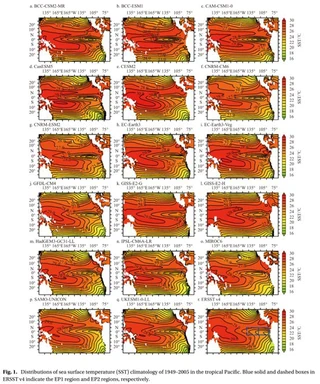
摘要
The sea surface temperature (SST) seasonal cycle in the eastern equatorial Pacific (EEP) plays an important role in the El Niño–Southern Oscillation (ENSO) phenomenon. However, the reasonable simulation of SST seasonal cycle in the EEP is still a challenge for climate models. In this paper, we evaluated the performance of 17 CMIP6 climate models in simulating the seasonal cycle in the EEP and compared them with 43 CMIP5 climate models. In general, only CESM2 and SAM0-UNICON are able to successfully capture the annual mean SST characteristics, and the results showed that CMIP6 models have no fundamental improvement in the model annual mean bias. For the seasonal cycle, 14 out of 17 climate models are able to represent the major characteristics of the observed SST annual evolution. In spring, 12 models capture the 1–2 months leading the eastern equatorial Pacific region 1 (EP1; 5°S–5°N, 110°–85°W) against the eastern equatorial Pacific region 2 (EP2; 5°S–5°N, 140°–110°W). In autumn, only two models, GISS-E2-G and SAM0-UNICON, correctly show that the EP1 and EP2 SSTs vary in phase. For the CMIP6 MME SST simulation in EP1, both the cold bias along the equator in the warm phase and the warm bias in the cold phase lead to a weaker annual SST cycle in the CGCMs, which is similar to the CMIP5 results. However, both the seasonal cold bias and warm bias are considerably decreased for CMIP6, which leads the annual SST cycle to more closely reflect the observation. For the CMIP6 MME SST simulation in EP2, the amplitude is similar to the observed value due to the quasi-constant cold bias throughout the year, although the cold bias is clearly improved after August compared with CMIP5 models. Overall, although SAM0-UNICON successfully captured the seasonal cycle characteristics in the EEP and the improvement from CMIP5 to CMIP6 in simulating EEP SST is clear, the fundamental climate models simulated biases still exist.
类型
出版物
Acta Oceanologica Sinica

Authors
研究员
博导,物理海洋学博士,研究员,目前担任学术期刊Ocean Modelling执行编辑、Scientific Data编委、中国海洋学会海气相互作用专业委员会秘书长、CLIVAR 海洋模式发展组OMDP委员等。一直从事地球系统模式发展与应用等方面的研究,率先将海浪的非破碎垂向混合作用和对海气通量作用引入到气候模式中,揭示了小尺度海浪过程在大尺度气候系统中的重要作用及机制;开展了海洋数值模式基于国产处理器的高效并行算法、地球系统模式的负载均衡算法以及AI4ClimateModeling等研究,有效提升了模式计算效率;发展了两代耦合海浪的地球系统模式FIO-ESM,通过完善模式所包含的小尺度过程,有效减缓模拟偏差,提高模拟和预测能力;构建了短期气候预测系统FIO-CPS,在国家海洋环境预报中心、国家气候中心等多个国家级和地方业务中心应用。先后主持NSFC青年、面上、重点、优青、杰青以及重点研发计划项目等多个项目;先后入选自然资源部第一海洋研究所“束星北”青年学者、自然资源部高层次科技创新人才领军人才和第二人才梯队等。

Authors
特聘研究员
研究员,自然资源部高层次科技创新人才工程“青年科技人才”、自然资源部第一海洋研究所束星北青年学者,是山东省自然科学基金杰出青年基金获得者。主要从事极地海洋学和极地气候变领域的研究工作,围绕北极气候变化,在气候变化机理研究、气候模式评估与改进和气候预测预估等方面取得了系列创新成果, 主要包括:研究揭示了北冰洋大西洋化进程中海-(冰)-气热通量在冰区与非冰区的相反变化规律,发现了“北冰洋放大”现象,阐明了北冰洋的快速变暖机制;系统评估了气候模式对北极海冰和北冰洋的模拟能力,量化了气候模式在北冰洋快速气候变化模拟中的共性偏差,改进提升了自主气候模式在北极的模拟能力;研发了北极海冰短期气候预测系统,构建了北冰洋动力降尺度数据集,成功应用于我国北极科考和北极航道商业航运的保障与规划。在《Nature Communications》、《Science Advances》、《Geophysical Research Letters》、和《Journal of Geophysical Research: Oceans》等期刊发表研究论文90余篇。
Authors

Authors
副研究员
主要致力于海洋数值模拟与数据同化研究,在国内外杂志上发表文章60余篇,承担了国家基金项目、国家973课题、公益性行业专项课题和重点研发计划等多项研究任务。近年来,在多变量联合同化调整和高效并行计算等研究方面取得重要成果,发展了海洋全要素高效并行数据同化系统,有效提高了海洋预报能力和气候预测水平,发布了我国首套全球高分辨率再分析数据。基于Kalman滤波原理,通过变量间的协方差表征海洋动力学特征以及多种影响因素之间的相互作用,有效利用观测信息优化其周围网的各种变量,实现多变量联合同化调整。作为核心成员,突破了负载近绝对均衡、主从核协同计算框架设计和循环折叠流水线等若干关键技术,为海洋数值预报系统建设提供了技术支撑。据此研发了海洋全要素高效并行数据同化系统,已成功应用到21世纪海上丝绸之路海洋环境预报、第二代海洋环境保障等多个预报系统,并支撑了气候预测和观测设计优化等研究的开展。
Authors
Authors
研究员
博导,物理海洋学博士,研究员,目前担任学术期刊Ocean Modelling执行编辑、Scientific Data编委、中国海洋学会海气相互作用专业委员会秘书长、CLIVAR 海洋模式发展组OMDP委员等。一直从事地球系统模式发展与应用等方面的研究,率先将海浪的非破碎垂向混合作用和对海气通量作用引入到气候模式中,揭示了小尺度海浪过程在大尺度气候系统中的重要作用及机制;开展了海洋数值模式基于国产处理器的高效并行算法、地球系统模式的负载均衡算法以及AI4ClimateModeling等研究,有效提升了模式计算效率;发展了两代耦合海浪的地球系统模式FIO-ESM,通过完善模式所包含的小尺度过程,有效减缓模拟偏差,提高模拟和预测能力;构建了短期气候预测系统FIO-CPS,在国家海洋环境预报中心、国家气候中心等多个国家级和地方业务中心应用。先后主持NSFC青年、面上、重点、优青、杰青以及重点研发计划项目等多个项目;先后入选自然资源部第一海洋研究所“束星北”青年学者、自然资源部高层次科技创新人才领军人才和第二人才梯队等。
Authors
Authors