Different Influencing Mechanisms of Two ENSO Types on the Interannual Variation in Diurnal SST over the Niño-3 and Niño-4 Regions

摘要
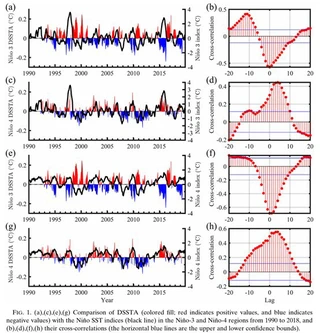
Inthispaper,thedifferenteffectsoftheeasternequatorialPacific(EP)andcentralequatorialPacific(CP)Ocean El Niño–Southern Oscillation (ENSO) events oninterannual variation in the diurnal sea surface temperature (SST) are explored in both the Niño-3 and Niño-4 regions. In the Niño-3 region, the diurnal SST anomaly (DSSTA) is negative during both EP and CPEl Niño events and becomes positive during both EP and CP La Niña events. However, the DSSTA in the Niño-4 region is positive in El Niño years and negative in La Niña years, which is opposite to that in the Niño-3 region. Further analysis indicates that the incident shortwave radiation (SWR), wind stress (WS), and upward latent heat flux (LHF) are the main factors causing the different interannual variations in the DSST. In the Niño-3 region, decreased SWR and increased LHF lead to a negative DSSTAinEPElNiñoyears,andenhancedWSandincreasedLHFcauseanegativeDSSTAinCPElNiñoyears.Conversely,in that same region, increased SWR and decreased LHF lead to a positive DSSTA in EP La Niña years, and reduced WS and decreased LHF cause a positive DSSTA in CP La Niña years. In the Niño-4 region, the reduced trade wind plays a key role in producing the positive DSSTA, whereas the decreased SWR has an opposite effect that reduces the range of the DSSTA during both EP and CP El Niño events, and conversely the enhanced trade wind plays a key role in producing the negative DSSTA, whereastheincreased SWRhasanoppositeeffectthatincreasestherangeoftheDSSTAduringbothEPandCPLaNiñaevents.
类型
出版物
Journal of Climate
Authors
Authors
Authors
Authors

Authors
研究员
博导,物理海洋学博士,研究员,目前担任学术期刊Ocean Modelling执行编辑、Scientific Data编委、中国海洋学会海气相互作用专业委员会秘书长、CLIVAR 海洋模式发展组OMDP委员等。一直从事地球系统模式发展与应用等方面的研究,率先将海浪的非破碎垂向混合作用和对海气通量作用引入到气候模式中,揭示了小尺度海浪过程在大尺度气候系统中的重要作用及机制;开展了海洋数值模式基于国产处理器的高效并行算法、地球系统模式的负载均衡算法以及AI4ClimateModeling等研究,有效提升了模式计算效率;发展了两代耦合海浪的地球系统模式FIO-ESM,通过完善模式所包含的小尺度过程,有效减缓模拟偏差,提高模拟和预测能力;构建了短期气候预测系统FIO-CPS,在国家海洋环境预报中心、国家气候中心等多个国家级和地方业务中心应用。先后主持NSFC青年、面上、重点、优青、杰青以及重点研发计划项目等多个项目;先后入选自然资源部第一海洋研究所“束星北”青年学者、自然资源部高层次科技创新人才领军人才和第二人才梯队等。