Effects of ITCZ Poleward Location Bias on ENSO Seasonal Phase-Locking Simulation in Climate Models
2023年8月1日·,,, ,,,
,,,
Xingrong Chen
Huaxia Liao
Xiaoyan Lei
Ying Bao
宋振亚
Huaxia Liao
Zhichao Cai
Jingsong Guo
宋振亚
Corresponding
·
0 分钟阅读时长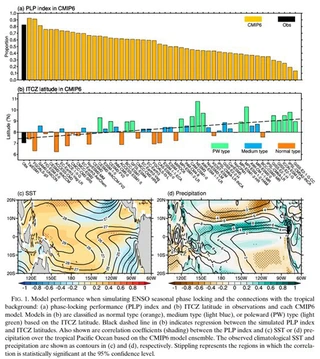
摘要
El Niño and the Southern Oscillation (ENSO) is the most influential interannual climate variability on Earth. The tendency of the mature phase of ENSO, characterized by the strongest sea surface temperature (SST) anomalies, to appear during the boreal winter is known as seasonal phase locking. Climate models are challenged by biases in simulating ENSO seasonal phase-locking. Here, we evaluated the ENSO phase-locking simulation performance in 50 Coupled Model Intercomparison Project Phase 6 (CMIP6) models, and found that the models with the Intertropical Convergence Zone (ITCZ) poleward bias tended to simulate more ENSO events that peaked out of the boreal winter season. The contributions of the ITCZ poleward bias to the ENSO phase-locking bias were also evaluated, yielding a correlation coefficient of 0.55, which can explain approximately 30% of the ENSO seasonal phase-locking bias. The mechanism that influences the simulation of ENSO seasonal phase-locking was also assessed. The ITCZ poleward bias induces a dry bias over the equatorial Pacific, especially during the boreal summer. During ENSO events, the meridional movement of the ITCZ is prevented, and the equatorial precipitation and convection anomalies that respond to ENSO events are also restrained. The restrained convection anomaly weakens the ENSO-related zonal wind anomaly, triggering a weaker eastern tropical Pacific thermocline anomaly during the following autumn. The weakened thermocline anomaly cannot sustain further development of ENSO-related SST anomalies. Therefore, ENSO events in models containing ITCZ poleward bias are restrained during the boreal summer and autumn and, thus, tend to peak out of the winter season.
类型
出版物
Journal of Climate
Bjerknes Feedback
Climate Model Bias
ENSO
Itcz
Phase-Locking
Intertropical Convergence Zone
Climatemodels
海洋数值模式
Authors
Authors
Authors
Authors

Authors
研究员
博导,物理海洋学博士,研究员,目前担任学术期刊Ocean Modelling执行编辑、Scientific Data编委、中国海洋学会海气相互作用专业委员会秘书长、CLIVAR 海洋模式发展组OMDP委员等。一直从事地球系统模式发展与应用等方面的研究,率先将海浪的非破碎垂向混合作用和对海气通量作用引入到气候模式中,揭示了小尺度海浪过程在大尺度气候系统中的重要作用及机制;开展了海洋数值模式基于国产处理器的高效并行算法、地球系统模式的负载均衡算法以及AI4ClimateModeling等研究,有效提升了模式计算效率;发展了两代耦合海浪的地球系统模式FIO-ESM,通过完善模式所包含的小尺度过程,有效减缓模拟偏差,提高模拟和预测能力;构建了短期气候预测系统FIO-CPS,在国家海洋环境预报中心、国家气候中心等多个国家级和地方业务中心应用。先后主持NSFC青年、面上、重点、优青、杰青以及重点研发计划项目等多个项目;先后入选自然资源部第一海洋研究所“束星北”青年学者、自然资源部高层次科技创新人才领军人才和第二人才梯队等。
Authors
Authors
Authors
Authors
研究员
博导,物理海洋学博士,研究员,目前担任学术期刊Ocean Modelling执行编辑、Scientific Data编委、中国海洋学会海气相互作用专业委员会秘书长、CLIVAR 海洋模式发展组OMDP委员等。一直从事地球系统模式发展与应用等方面的研究,率先将海浪的非破碎垂向混合作用和对海气通量作用引入到气候模式中,揭示了小尺度海浪过程在大尺度气候系统中的重要作用及机制;开展了海洋数值模式基于国产处理器的高效并行算法、地球系统模式的负载均衡算法以及AI4ClimateModeling等研究,有效提升了模式计算效率;发展了两代耦合海浪的地球系统模式FIO-ESM,通过完善模式所包含的小尺度过程,有效减缓模拟偏差,提高模拟和预测能力;构建了短期气候预测系统FIO-CPS,在国家海洋环境预报中心、国家气候中心等多个国家级和地方业务中心应用。先后主持NSFC青年、面上、重点、优青、杰青以及重点研发计划项目等多个项目;先后入选自然资源部第一海洋研究所“束星北”青年学者、自然资源部高层次科技创新人才领军人才和第二人才梯队等。